So recently all of us who love animals had a major blow. A giraffe nicknamed Marius was killed simply because there was not a place for him. Many people, myself included, were heart broken. Some people were so offended by this that the zoo received many death threats. I, however, look at this from a whole different point of view.
No sane person wants to kill animals. We all wish there was home for each and every one of them. Unfortunately we are simply not able to. We can't save every giraffe, nor every kitty.
Let's go on a little detour for a minute or two. Let's say you want to save cats. You decide to run a shelter. You can either be an open admission shelter and take every animal that comes to you, or a closed admission shelter (often called 'no-kill') and choose ahead of time that you will only take animals when you have room to house and money to take care of. Remember, there will be a steady stream of homeless and unwanted animals and there is a far smaller amount of people who are looking to adopt. What do you do?
If you are lucky, you have a network of shelters and people you trust. You can send animals you can not save yourself to other shelters where demand is higher. But there aren't a lot of shelters out there who have a demand higher than their intake. So you try to find no kill shelters to take them.
Unfortunately no matter how well you check out these shelters,
sometimes you end up doing business with places that are
little more than hoarders at best.
Now remember resources in rescue are limited. They will always be limited. At this point we can not even save all of the humans. We, as a country (USA), are cutting programs left and right that are currently supporting a good number of people so the governments aren't able to save them. People are only able or willing to give so much. Land costs money, buildings to house them cost, people to care for them, food to feed them, tests to make sure they are healthy, vaccines, deworming, electricity to see, heat to be warm, phones to reach people, internet to network them, computers to keep track of things, medical care to fix those that are fixable and keep them healthy, insurance to protect against things you can't think of, cages, beds, litter, toys, paper, postage, cars for transporting animals to the vet, gas and insurance for those cars, etc.. and yet people have a very very hard time paying adoption fees. When you tell a person that a cat at your shelter is $100 to adopt, despite often investing several hundred dollars in their care, the public often balk at price and claim they can go down the street and get one for free..
So, lets get back to you
running a shelter. What do you do? Did you choose to only help those you can afford to take in and be a 'closed admission' shelter. Many shelters
choose to keep their doors open and take in every animal that comes to their door knowing if they are turned away they will most likely be abandoned on the side of the road,
left behind at a house with out food, or
killed inhumanely. We are not so far away from the days of
sacks in the river that we should have forgotten that. There are still stories now of people who do inhumane things to remove the pets from their lives. A few years ago a local to me cat was saved from a garbage incinerator... the owner threw it away while it was in a carrier, and the carrier was on the conveyor belt on it's way to be incinerated.
In order for those doors of your shelter to remain open, you need to have room to house them and staff to care for them. Generally the only way to ensure that is to euthanize those that are there who have not been adopted. You can try to find others who might have room to take them, but as I mentioned above, how can you be sure they will abide by the same values that you do. If you do decide to let rescues take some of your cats off your hands, how long will it be until they are full up too and how much does it cost to transport them there? You can drop your adoption fees and give the cats away, but how will you continue to fund your shelter when people start expecting the cats to be free? You can try satellite adoptions, or adoptathons, or other gimmicks to get people in to adopt, but that takes time and money and manpower. Don't get me wrong, it can be done. I volunteer for an open admission shelter with 'no-kill' adoption rates, but it took them years and a lot of resources to get there. Simply telling people to not kill is about as inane as
telling poor people not to be poor and worse it is actually harmful because remember shelter workers do not want to kill an animals. They started working at a shelter to save animals, and when fanatics stand on the sidelines and use inflammatory language and using faulty math to 'prove' a point, it is harmful to those who are on the front lines. Telling people to not support open admission shelters simply ensures that more animals will die. Education, not rhetoric, will be the only thing that saves lives. If you do not like how many animals are killed, do not stand on the sidelines and decree them evil and uncaring, get in there and help.
So knowing that you have more animals than you can care for, you choose to euthanize to make room for the next ones that are coming in who will need to be housed for the amount of time required by law. This is very hard on everyone. To save the staff the burden of having to decide who and where and when to kill, which is very hard on the human psyche, policies are put in place that calls for animals to be put down after a certain amount of time, or the ones that have been there the longest, no matter how cute or deserving they are to live. Although I cannot tell you how much I hate that term because really, which cat is not deserving to live?
 |
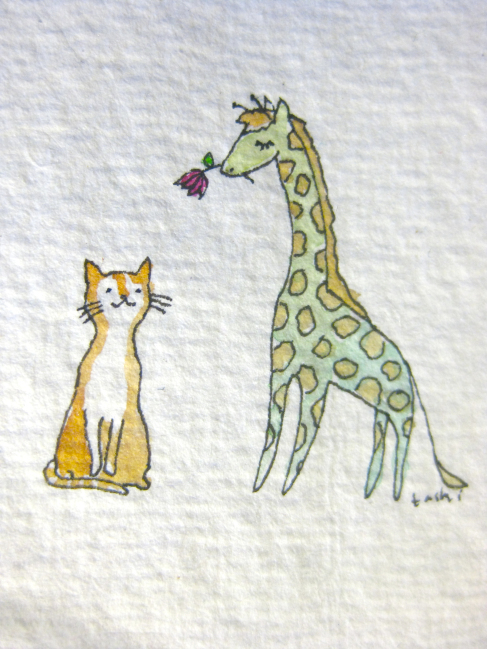
A Cat and A Giraffe by Tashi Cards
used with permission |
When you run a zoo, you need to make those same decisions but on a whole different level. You are intending on housing these animals for their entire life. Part of the charter of a zoo is often to help the species with out ever having to take in another one from the wild and hopefully make it possible to repopulate endangered species.
So do zoos still have a place in this day and age? Originally 3000 years ago exotic animals were kept by the wealthy and the rulers as status symbols. As time went on people realized they could make money by showing off animals. Often these animals were not kept well, and we still have these types of attractions in those road side attractions that are dotted across the land. As time went on people realized the need to treat the animals with respect, to learn from them and to help conserve them. You can talk to someone about a lion or a lemur but until you are able to show it to them they will not fully understand nor make that connection deep with in their soul. I've loved polar bears for years, seen them on TV, watched people get up close to them on
specials on Churchill but when I was less than a foot away from one in a zoo I got goose bumps.
Zoo animals have far greater need for enrichment. This is a life long placement and their territories are limited. So you need to make these decisions for their greater good on a much grander scale. You need to provide for their mental as well as physical health. You need to provide for future generations to keep the zoo running and interesting to the public so they continue to fund you.
The
EAZA, the European Association of Zoos and Aquaria, made these decisions in what they believed was the best interest of the animals in their care. Like the above example with your hypothetical shelter, they made these decisions prior to the need of any one specific animal and in the best interest of the species of animals in their care. They wanted to ensure the health and well being of their animals, they want to ensure that the facilities were well attended to be able to keep the facilities running, and they also want to make sure they have reasons for the public to show up and want to support the zoo.
Marius was not owned by the zoo he was held in, but by the EAZA. The EAZA has decided that animals they own - for the safety and long term health of these animals can only be kept in EAZA zoos. If they are part of the association, then they know the animals will be safe. Are other zoos safe places? I'm sure many of them are, but how many of them aren't? I do not know. The EAZA decided they didn't want to waste their time and resources trying to determine if other zoos are or not or will be in the future. I am guessing they felt that their time and resources are better spent on maintaining what they do have. Animals sold to non associated zoos can not be tracked and there is no guarantee they won't end up in a
road side attraction or in a small pen alone and living a life that most would consider cruel, or worse.
Many wonder why Marius was even allowed to be born. First off, the EAZA has decided that artificial means of birth control will dramatically alter the animals in their care to a point where they have decided that is unacceptable. While the neutering of companion animals is a good thing as it allows the animals to live in a home environment, it is not a good idea for animals in a group setting. It changes their dynamics. Hormones are very important to wild animals, it dictates a lot of their behaviors. Well what about a vasectomy? It would keep the hormones in tact, but it would alter the animal's ability to sire off spring - which is something the zoo is very much in need of.
Why? They were just going to kill this one, so why were they in need of it? Well there is that crass matter of money. Baby animals do attract a lot of visitors and a lot of visitors generates a lot of money. But it also generates a lot of supporters. People who are willing to continue to fund the zoo long after the babies are grown up and no longer 'cute'.
Babies are also social enrichment for herd animals like the giraffes. Having a younger in the fold gives the parents a chance to parent, and the herd a chance to baby sit and bring a whole new dynamic to the heard. It allows giraffe to be a giraffe.
Why not keep Marius. Well it is expensive and I have already established that money / resources are limited. Why not send Marius to another zoo? When you do not have control over the zoo you are sending an animal to, you can never really be sure what kind of life that animal will have. Do not forget that transporting a giraffe is a very expensive proposition, and
not with out it's risks, including death. People often decree that any life is better than an immediate death, but I am pretty sure they are not seeing the big picture of all of the inhumane things out there. What about another EAZA zoo? There was one that offered to take Marius, but his brother was there and they were once again faced with basically the same situation.
So why did they kill Marius in the way they chose? I do not know, I'm not them, but I know what they told the world, and I can speculate a little. They wanted to do it out in the public so people could learn. Yes, they allowed children to view it. Every single child there because their parents thought it was appropriate for them. News articles had a field day using inflammatory language to make this as horrific as possible. They didn't just walk into the enclosure and kill Marius with no warning. They also ensured that his last few minutes on this earth were happy ones. They then necropsied to share giraffe anatomy with the public. Some people had a real problem with this. I say there is no other way to really experience something with out being there. It is why we travel, why we go to concerts... why we go to zoos when there are photos in books or on the internet. One of the most awe inspiring moments of my life was when I was a mere six inches away from a swimming polar bear..
I also applaud their decision to not let his body go to waste and instead use it to enrich the lives of the lions, tigers and leopards. (I highly recommend the reading of this article)
I would also like to speculate what better way to force this world to have this conversation! I sure do hope that people start looking beyond the rhetoric of "STOP THE KILLING" and actually start looking into the logistics of it, and what it actually takes to provide for every animal.. Seeing the big picture is the only way to begin to fix it. While I have my doubts that we will ever be a 'no kill' nation, know that the kill rate of companion animals is
10% of what it used to be in the 70s and
are still improving. They will only continue to improve if we do something, not just say we want things done.