As I stated in my
previous post, I had (and still have) no idea why I was invited to the PNC. Most of the time I had this "what on earth am *I* doing here" feeling and it probably colored a lot of my views. I am grateful for the opportunity, but I was pretty sure I wasn't there to give my opinions or even to have them asked.
So OK. What did Hill's have to say about it?

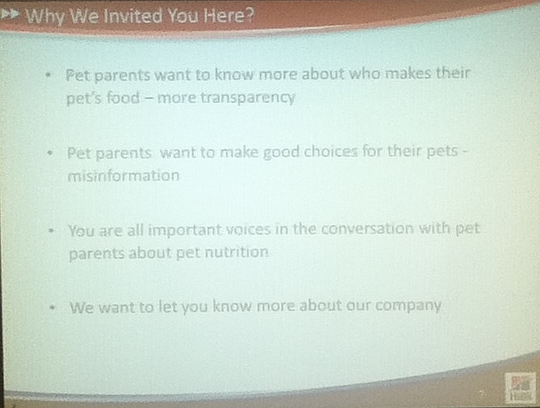
I was furiously scribling away trying to get the contents of this slide and not really able to listen to Kostas Kontopanos, the president of Hill's, speak. So I thought I was clever and took out my iTouch and snapped a photo of the slide. When I read the agenda that said no photographs could be taken, surely they didn't mean of presentation materials?? I wasn't the only one that had this idea and a few other people took out their phones and took photos of the presenters. Shortly there after we got the "No Photographs" reminder (in a very pleasant and nice tone). Really? No photographs of the presentation materials for this tour? I could sorta understand not wanting us to photograph every inch of the facility, but limiting this?? *shrug* Seems kind of odd to invite a bunch of bloggers - and most of the internet relies on visual materials - and not let them take ANY photos. Yes, photos were provided, but only after the END of the tour, so I had really no idea what was going to be given to us. I was really quite bothered by this. Not only because I could not share what I personally saw thus lending some authenticity to my post, but to me using someone else's photos is a bit like using someone else's words.
Well anyway.. No photos meant NO photos.. OK no biggie. moving on. (aka I'm sorry for the lack of visuals)
Two major themes ran through the presentations of why we were there. One was "misinformation" the second was "complete and balance". They believe there is so much misinformation out there about their products and that is why people choose not to use them. I got the impression that they felt if they could just convey what they do that I, and others, would be right on board with what they do and why. The complete and balanced message was that their food is very similar to
baby formula in that it needs to provide all of the nutrients the individual needs.
There were some absolutely wonderful presentations while we were there. Many were all too short. One in particular about reading food labels was quite interesting (and a bit telling) by Bill Schoenherr, PhD (animal nutrition). He started out with a mocked up ingredient list. He said he knows from his computer programs which ingredients provide which nutrients needed to fit the profile of nutrition they wanted for the food they would create. Then the program lists the ingredients for the label in order of weight. So which ever ingredient weighs most goes first. Does that mean it has the 'most' of it? Well depends on your definition of 'most' An ingredient like fresh chicken has a lot of moisture as part of it's make up. So automatically it would most likely get listed first. That doesn't mean that on a dry matter basis there isn't more of the second or third ingredient in the product. Does this matter? It all depends on your perspective. Do you think that the water content of meat is important? Do you think that dehydrated products ground up and then rehydrated is just as good as fresh? There are also requirements for how things are labeled on the front, but talking about that would simply make this post much closer to a book, but you should know that every single word on your package of food was put there with intent and most have legal ramifications behind it. It was stated that the packaging is a legal document. Interesting way to look at it and knowing this might just change how you look at a package of pet food.
What I found amazing about Dr. Schoenherr is that his wife runs a business that he helps with and he is quite proud of. She was actually at the local farmers market that morning selling her fresh made bread. The wheat was sourced locally and freshly ground. The eggs come from
chickens that are pasture raised.
You know, all that stuff that farmer's markets are known for. Well to me that bread sounded fabulous and I raised my hand and jokingly said I would love a loaf of that bread and wouldn't you know it he brought a couple of loaves back for lunch for everyone to have a slice or two of. Not being a huge bread eater right now I was a little glad I didn't get a whole loaf (that and I would have had to some how get it back on the plane) But here is a guy who spends all day looking at /dealing with / studying nutrition for pets at this huge facility and is perfectly OK with sourcing animals and animal products from
CAFOs and the plant based ingredients that are more then likely
GMO and grown with
pesticides; all while praising the bread his wife makes (and oh so he should!). To me this dichotomy stood right out.
But they have their "science"
* to prove what they are doing is right and best for the animals. They have the PhDs and the years of study. When the forum was opened up for questions, the question of a grain free food came up and Mr. Kontopanos himself fielded that question. Now maybe I'm reading into the situation, I so hope so but I don't think I was, because his reaction was almost one of annoyance. His answer to the group was something along the lines of when the demand for fresh meat was heard we started adding fresh meat even though the cost to ship it to the plant was so much more then that which was being used because it is dried, the water makes it so much more expensive. We are currently using grains because it is part of our complete and balanced program but if the demand is there we will find a way - total paraphrasing, and if anyone can help me clarify that a little better I will be happy to correct it. The answer I got from his body language and tone and just the general impression of reading him while he was talking was "oh these people just want something else that is so expensive and unnecessary to do because we can do it how we are doing it and doing it the other way isn't better, just more expensive" I got the feeling he was set on using grains and cereals and at that point my question about obligate carnivore and the fact that the cats lack the digestive enzymes to access the nutrients in plant based ingredients died in my throat. They do not want to do something different. They believe in their products and that was that.
As I mentioned in my last post, during the tour it was mentioned that the cats intake is closely monitored. Each one has an RFD chip in them and when they walk up to a food station the station reads the chip, makes note of the cat, and identifies if it has any of its allotted portion left. If it does, the feed station opens. It then monitors by weight how much the cat has eaten, and if it has eaten its portion it then will not open again that day. Walking through the hallway between the cat rooms we could clearly see that many of the cats were overweight. I asked about that later and was told that the cats are clever (go figure) and since the top of the feed station can't sit directly ON the bowl (because it is weighed) the cats have figured out how to paw their way through and get the food they want. This left me wondering all sorts of questions, but most of those types of questions by others on the tour were answered with a very "political" type of answer. The "yes, that is a good point now let me direct your attention over here where I'm going to get off that point and on to the talking point I want to talk about" type of answer. Now granted we were therefore only a handful of hours and we didn't have time to get into the nitty gritty of things so I can see why they would do that, but more often then not it left me wondering.
The cats (and dogs) were there to do food trials as mentioned. They believe these food trials are a good thing, even if it is on just a handful of animals for just a handful of weeks.
The protocol requires six of eight animals complete a 26-week feeding trial without showing clinical or pathological signs of nutritional deficiency or excess. The cats' or dogs' general health is evaluated by a veterinarian before and after the test. Four blood values (hemoglobin, packed cell volume, serum alkaline phosphatase and serum albumin) are measured after the trial, and the average values of the test subjects must meet minimum levels. No animal is allowed to lose more than 15% of its starting weight. ~Wikipedia (sourced to http://jn.nutrition.org )
So how does Hill's go about making a food that is "complete and balanced". What does that mean? What is the science behind it. Well studies were done and the nutritional content of food that kept pets alive and kept those four blood levels in check and weight stable-ish. The list of those requirements are in the
jn. nutrition.org PDF I looked for them on the
AAFCO website and could not find them. Since all the
GRAS (Generally Recognized As Safe) ingredients has been tested and calculated and are in a computer program, they can now create foods on the computer with out doing a test on the actual food as long as the nutrients in question meet the guidelines. Although according to the PDF,
"Pet foods that successfully pass the feeding trials are exempt from the requirement to meet the profiles". Hill's is currently touting their "Nutrigenomics" research program. It
is dedicated to applying the latest scientific tools and technologies in order to find new ways to make better, more effective pet foods. Discoveries made in the Nutrigeomics lab enhance our understanding of how nutrients and ingredients in pet foods interact in the body. Through this cutting-edge research, Hills has developed an exceptional understanding of the molecular basis of disease and health, the biochemical response to food, and the role that nutrients play in the health of dogs and cats. (direct from Hill's handout) To this end they are funding research to develop the cat genome. Hill's is the only pet food manufacturer applying Nutrigenomics to the development of cat food. (paraphrased from same Hill's handout) This implies that they have additional measurements they take and use to quantify their results. But what those are and how they go about it... well that is proprietary.
Manufactures of dry pet foods, including Hill's, don't seem to consider it important that cats are obligate carnivore and do not have the
digestive enzyme amylase to digest the cells that the nutrients that are contained inside. The thought seems to be that cats eat mice, mice eat grain, so when cats eat mice they get grain, there for cats should eat grain. I wish they would consider that a) the mouse chewed the food, b) the mouse does have the digestive enzymes to break down the food and c) there is less then
2% by weight of grain in any given mouse and that would be if the mouse just ate.. We also should not forget, scientists very similar to the ones in Hill's employ now didn't see the need to supplement cat food with Taurine until the 70's.. What else do they not know? Don't think I'm only picking on the scientific view of nutrients on pet food, human nutritional scientists don't do much better. For example just recently they discovered the enormous need for Vitamin D. Until these things are discovered they are considered irrelevant.
Remember the "food of the future" back in the 50's when it was thought that one day we would all be eating pills for all of our nutrients and we could do away with actual food?? (
I mean didn't you want to eat like the Jetsons?) Look at all the discoveries since then.
Lastly I asked about why there can't be actual calorie counts on pet foods. Why do human packaged foods give you calorie/fat/protein/carb counts but pet food only gives you the guaranteed minimum and maximums on a few key required values. Again, I am paraphrasing here, because I was so incredibly shocked by the answer that I didn't catch absolutely everything she said. But the general answer was 'well they (meaning human food packaging labels) do the same thing, they just don't tell you'. Which to me meant she believed that the laws for human packaging do not require they put EXACT amounts of each nutrient in the product. I know there is leeway when they test to account for variants, but
I am pretty darn sure the FDA requires that companies tell us EXACTLY what is in the food we humans purchase for the nutrients we have been able to quantify and believe, at this time, to be important
In the end I did have a bit more respect for Hill's and the passion and care they do take. I also have a great deal less due to some blatant sidesteps around facts I know to be true. No. I am not a scientist. No, I don't have a PhD after my name. I didn't go to college to study nutrition. I am just one woman who had a slew of issues, when following "conventional' wisdom, in my pet's health as well as my own. I did a bunch of reading and followed the research to the source and learned all I could. One woman who saw these issues greatly improved when I started following "unconventional" and "controversial" points of view on health and nutrition. I also know I'm not alone in this journey.
Do I think Hill's is "WRONG".. No. (hold on hold on.. keep reading) I think they are doing what they believe to be best. The employees all take great pride in what they do, how they do it and why they do it. It is not like they are an "evil corporation" out to destroy the health of the animals they feed. They truly believe in their products which is admirable. They have many vets who believe in their products. They have many pet owners who believe in their products. They are easy, they are convenient, and they do what they say they do. Are they the best we can offer a pet? I do not believe so, I believe there is better. Easy and convenient are not how I choose what to feed my pet, nor myself, because I truly believe there is often a price to pay for it. But easy and convenient are two requirements for a lot of pet parents and I would much prefer that pets live in homes and eat "complete and balanced' food and know love then live on the street and eat mouse.
Do I think one day someone somewhere is going to fund a study that proves that the piecemeal approach to nutrition is always going to be incomplete? Man I hope so, but I just don't see anyone funding that.. There is no money in studying why the mouse, the rabbit or the song bird are better sources of nutrients for cats then highly processed high in plant matter foods. Hill's has a financial gain in proving their food is healthy... thus those are the studies they are going to fund. Iams has the same goal, as does Royal Canin and any other pet food maker who wants to fund studies in nutrition. They come up with the theory, like the one 'minimal iodine in food will help thyroid patients" and they test it (on a minimum of 6-8 animals for 26 weeks - but considering Hill's said they do their prescription diet tests in house on 30 animals it was probably a bit more then that) and if they hit their goal then it is good for ALL pets who have thyroid issues. (but history has shown us these types of tests can be faulty, just look at Vioxx, Lipitor, Fen-Phen, and Zocor) So what if
there is no actual meat in the dry version of this type of food and it is basically a vegetarian product (save for some animal fat)
I think they could do more. I think they could do better. But that is not the service they want to provide. If you want a more "whole food" food then Hill's is not for you. If you believe in convention and convenience, Hill's would very much like you as a customer.
I plan on doing a follow up to these two posts on my opinions on the matter of species appropriate foods for cats in the next week or two. There is SO much information out there that it is very hard to digest it all. I by no means know it all and I am very much open to the fact that I could be mis-informed, or that the information we know to be true now isn't all there is to know. Which is why I am constantly reading all I can on the subject.
If you have actually read all this (and I am impressed because posts with out visuals are sometimes hard to get through) and you want to read more you can check out - in no particular order:
Overwhelmed yet? Easy and Convenient sounding better and better? I can so totally understand that. I was first introduced to raw (it was BARF back then) by a woman I met online. She told me she had decided to feed raw, and I asked her about it. I didn't understand the appeal since "my vet told me" that commercial foods healthy. Many believe dry food is no different from wet food. (I know someone who was once told the only difference was the water content - why the vet didn't look at the ingredient list and see the difference I have no idea) Unfortunately she couldn't really explain it to me at the time. She didn't have the resources yet to explain her choices and so I passed it off as a fad and continued to feed easy and convenient. Oh if only...