Over the years, I have spent quite a bit of time reading about feline nutrition. The more I learn, the more I am bothered by the state of commercial pet foods. I would love to spend the time discussing why, but
others have done that and I couldn't do it justice nearly as well.
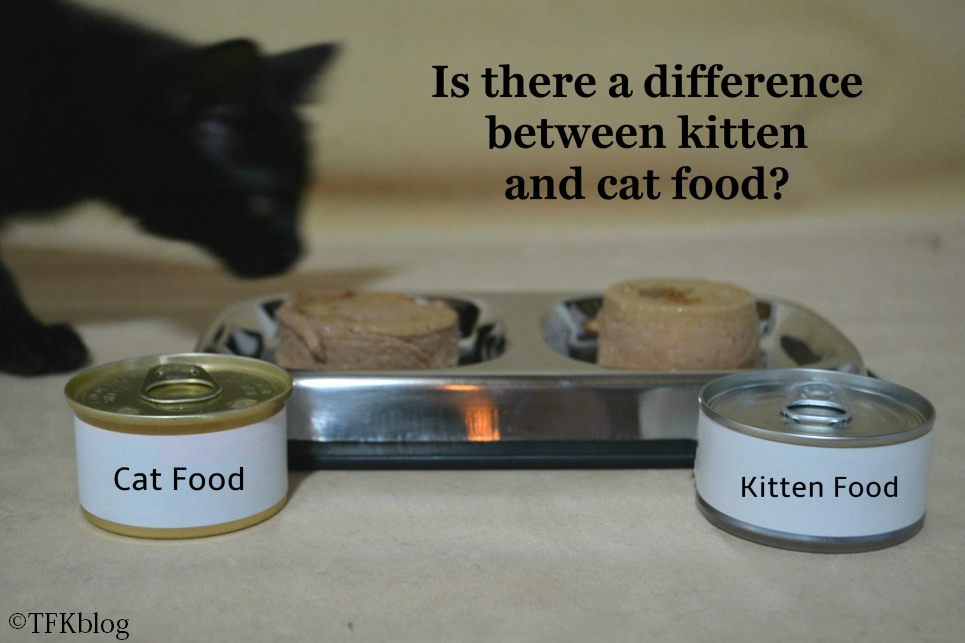
What I do want to address is the commercial pet food's "kitten food". There are many people out there who believe there is such a dramatic difference, between 'cat' food and 'kitten' food, that to feed their kittens cat food will harm their kittens.
This is not the case.
Yes, there are nutrients that kittens need more of than adult
cats, but these are addressed through proper feline nutrition to begin with. If you feed a high protein / low carbohydrate cat food, it is good for all life stages, just be sure to feed more of it to as
kittens often require double or triple a number of calories than adult cats.
How do I know this? Because in the wild, there are no 'kitten mice' Whatever mom brings home to eat, the kittens eat.
Would you like a more scientific answer? Check out this PDF on
Your Cat's Nutritional Needs by the National Research Council of the National Academies that states:that a kitten needs 10 g of protein and 4 g of fat whereas an adult cat needs 12.5 g of protein and 5.5 g of fat. Sadly most pet foods do not give you specifics when it comes to what exactly is in their pet foods when it comes to calories and protein levels, but you can get a guess.. that PDF even gives a very good method to help you do a little detective work to figure it out
Determining Grams of Essential Nutrients from Petfood Labels
Petfood labels do not generally list amounts of essential nutrients in grams.
However, all pet food labels must state guarantees for the minimum percentages of
crude* protein and crude fat, and the maximum percentages of crude fiber and
moisture. To convert these percentages to grams, simply multiply the crude percentages
times the weight of your cat’s daily portion. For example, if you feed your
cat one 6-oz (170-gram) can of food per day, and the food contains 8% crude protein,
the grams of protein would be 0.08 x 170 =13.6 grams.
*”Crude” refers to the specific method of testing the product, not to the quality of the nutrient itself.
We also know that kittens burn through calories like it is their job so it is necessary to provide them with food far more frequently than an adult cat needs to eat.
Want more scientific requirements on nutritional requirements for cats vs kittens (and dogs) check out the
Merck Veterinary Manual on nutritional requirements. There is very little difference when you consider the "minimum" vs "maximums" vs the recommended allowance.
More proof?
Here is the ingredient list of one brand of
turkey kitten food
turkey, liver, meat by-products, poultry broth, milk, egg product, artificial and natural flavors, calcium phosphate, guar gum, potassium chloride, added color, magnesium sulfate, salt, taurine, vitamin e supplement, zinc sulfate, thiamine mononitrate, ferrous sulfate, niacin, copper sulfate, manganese sulfate, calcium pantothenate, vitamin a supplement, menadione sodium bisulfite complex (source of vitamin k activity), pyridoxine hydrochloride, riboflavin supplement, vitamin B-12 supplement, biotin, folic acid, vitamin D-3 supplement, potassium iodide
The nutritional information on it is as follows:
- Crude Protein (Min) 11.0%
- Crude Fat (Min) 6.0%
- Crude Fiber (Max) 1.5%
- Moisture (Max) 78.0%
- Ash (Max) 3.5%
- Calcium (Min) 0.3%
- Taurine (Min) 0.07%
The ingredient list of the same brand's turkey and giblet cat food:
turkey, liver, meat by-products, turkey broth, poultry giblets, artificial and natural flavors, guar gum, calcium phosphate, potassium chloride, salt, magnesium sulfate, taurine, zinc sulfate, thiamine mononitrate, vitamin e supplement, ferrous sulfate, niacin, manganese sulfate, calcium pantothenate, vitamin a supplement, copper sulfate, menadione sodium bisulfite complex (source of vitamin k activity), pyridoxine hydrochloride, riboflavin supplement, vitamin B-12 supplement, biotin, folic acid, vitamin D-3 supplement, potassium iodide
The nutritional information:
- Crude Protein (Min) 11.0%
- Crude Fat (Min) 5.0%
- Crude Fiber (Max) 1.5%
- Moisture (Max) 78.0%
- Ash (Max) 3.0%
- Taurine (Min) 0.05%
Did I mention there was no such thing as kitten mice?
Now there are some minimal differences in the food, the base amount of taurine is only promised to be at least 0.05% in cat food and it is promised to be at least 0.07% in the kitten, but those are only minimums. Because of the meat content and the added taurine, the chances that the kitten isn't getting enough taurine is minimal. If you are providing them a good quality diet, it does not matter if it is "cat" or "kitten" food. What matters is that you are feeding them enough food, so feed them frequently and as much as they can possibly eat. I do not believe you can overfeed a kitten as long as they are deciding how much to eat (if you are force feeding, that is a different story). If they are not hungry, they will not eat. They are far far too busy playing, and learning, and hunting, and wrestling and sleeping to sit at a food bowl all day and eat if they aren't hungry. Once they have finished their growth cycle things will change, but as for kittens, if they are hungry, feed them.